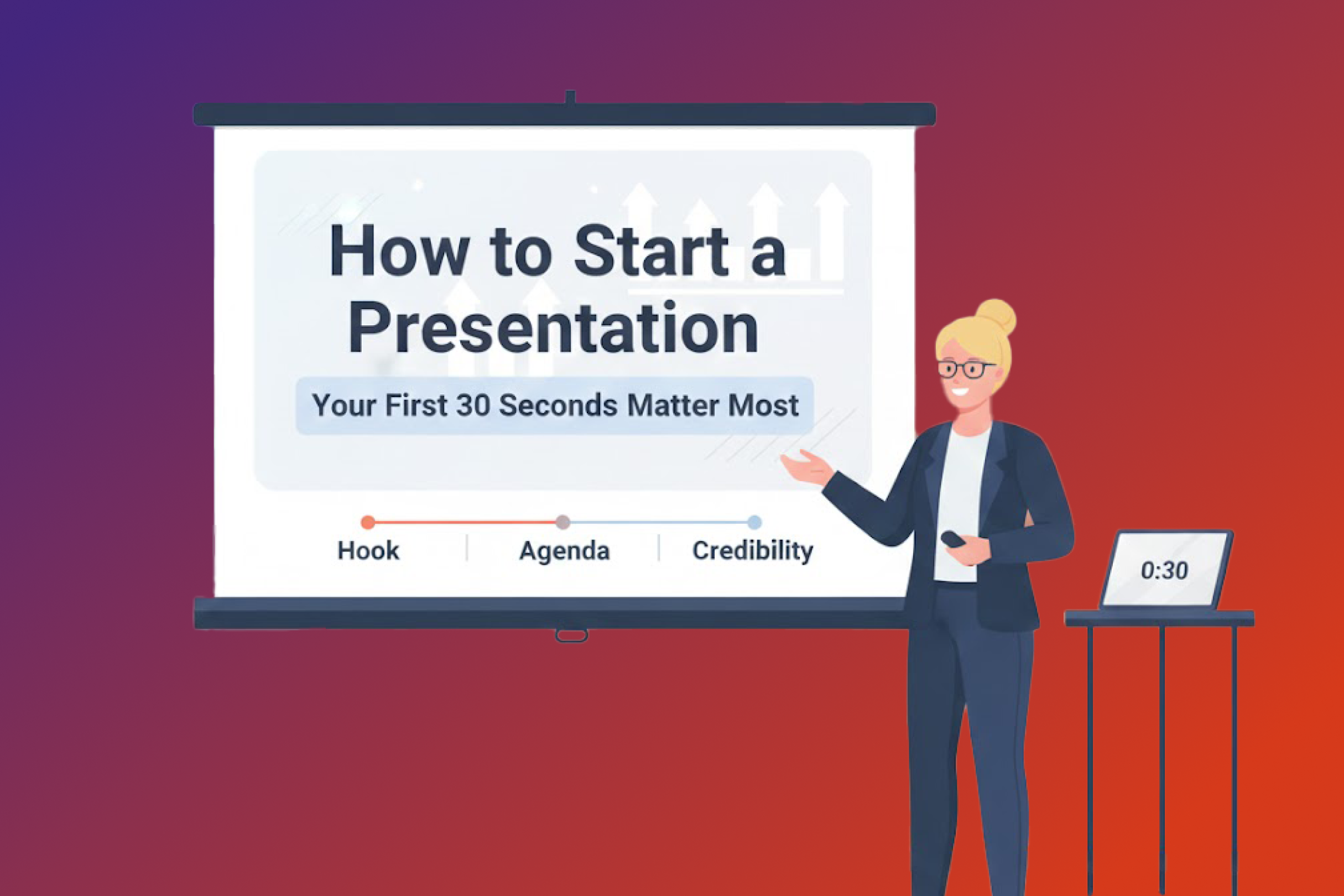
Introduction: Why the First 30 Seconds Decide Everything
The way you start your presentation determines whether your audience listens or not. Research shows that people form an impression within seconds, and once attention is lost, it’s complicated to win back. Yet many presenters begin with weak openings, long introductions, agenda dumps, or apologies. If you want your message to land, your first 30 seconds must create clarity, relevance, and curiosity.
In this guide, you’ll learn how to start a presentation effectively, presentation opening techniques that work across meetings, pitches, classrooms, and conferences, and also some practical examples that you can apply immediately. You’ll also see how modern AI-powered presentation platforms can help to create a strong opening faster.
Why the First 30 Seconds Matter in a Presentation
The opening moments of a presentation set expectations for the audience. Before a single slide is fully read, your audience is already forming opinions about the value, clarity, and relevance of your presentation. These early seconds influence how people listen, how much effort they invest in understanding your message, and whether they engage throughout.
To understand why this window is so critical, let’s look at what actually happens in the audience’s mind during the first 30 seconds.
Attention Is Fragile
According to studies referenced by Harvard Business Review, audience attention drops sharply when a speaker fails to establish trust early. People decide almost instantly whether something is worth their time or not.
In a presentation, the first 30 seconds answer three unspoken questions:
- Why should I listen?
- What is this about?
- What’s in it for me?
If these aren’t clear quickly, engagement reduces.
Strong Openings Create Authority
A strong and confident opening sets your credibility. It signals that you know your end goal, you respect the audience’s time, and you have a clear message. But weak openings do the opposite, even if the content itself is strong.
How to Start a Presentation the Right Way
1. Start With a Clear and Relevant Hook
A hook is not a joke or a dramatic pause, but it’s a reason to care.
Effective hooks include:
- A surprising fact or statistic
- A short, relatable story
- A bold statement
- A thought-provoking question
Example: “Did you know that 90% of presentations fail because of their opening, not because of their content?” This immediately creates curiosity and relevance.
2. Make the Audience the Focus
One of the most common mistakes is starting with self-introductions or company history. Your audience cares first about their problem, not your background.
Instead of:
“I’m here today to talk about marketing strategies…”
Try:
“If you’ve ever struggled to keep people engaged in your presentations, this session is for you.”
This shift instantly increases attention.
3. Clearly State the Outcome
Within the first 30 seconds, your audience should know what they’ll gain.
A strong opening includes a simple outcome statement:
- What they will learn
- What problem will be solved
- What decision will they be able to make
Example:
“By the end of this presentation, you’ll know exactly how to structure your opening to capture attention every time.”
Proven Ways to Open a Presentation with Examples
Start With a Question
Questions activate thinking.
Good examples:
- “What would you do if your audience stopped listening after 30 seconds?”
- “Why do some presentations feel effortless while others feel exhausting?”
Avoid generic questions like “Can everyone see the screen?”
Start With a Short Story
Stories build emotional connection quickly.
Example:
“Last month, a founder walked into an investor meeting with a great idea but lost attention in under a minute. Not because the idea was weak, but because the opening was unclear.”
Stories make abstract ideas concrete.
Start With a Data Point
Statistics work when they are relevant and simple.
Example:
“Studies show that audiences remember only 10% of a presentation, but that number doubles when the opening is clear and engaging.”
For proven techniques on engaging audiences from the start, resources from Toastmasters International provide practical guidance on presentation skills and speaker impact.
How to Structure the First 30 Seconds of a Presentation
Use this simple framework:
- Hook – Grab attention
- Context – Explain why this topic matters
- Outcome – Tell them what they’ll gain
This structure works for:
- Business presentations
- Pitch decks
- Training sessions
- Classroom lectures
If you use these with a clean slide design, it becomes even more effective. Tools like RocketSlide – an AI presentation maker can help you quickly structure this opening without overloading slides with text.
The ending of your presentation matters equally. If you want to read more, you can check out our article on how to end a presentation effectively.
Common Mistakes to Avoid When Starting a Presentation
Reading From Slides
Slides should support your opening, not replace it. A strong opening is spoken, not read.
Overloading With Information
Don’t start with:
- Full agendas
- Dense data
- Long explanations
Save details for later.
Apologizing or Underselling Yourself
Avoid phrases like:
- “I didn’t have much time to prepare.”
- “This might be boring.”
They instantly reduce trust.
Using Visuals to Strengthen Your Opening
Your opening slide should reinforce your message visually.
Best practices:
- One clear headline
- Minimal text
- A relevant image or statistic
If you’re using AI tools to create slides, platforms like RocketSlide’s AI presentation generator help turn your opening idea into a clean, professional first slide without manual design effort.
How AI Tools Help You Start Presentations Better
Modern presenters increasingly rely on AI to save time and improve clarity.
AI-powered tools can:
- Suggest strong opening headlines
- Structure your introduction logically
- Maintain consistent design across slides
If you’re new to this, you may find this guide helpful - How to Make a PowerPoint Presentation with AI in 2026.
Using AI doesn’t replace thinking; it removes friction so you can focus on the message and delivery.
Practical Tips for Different Presentation Types
- Business & Sales Presentations: Start with a problem your audience recognizes immediately.
- Pitch Decks: Open with the pain point, not the solution.
- Educational Presentations: Begin with a real-world example before theory.
- Internal Team Meetings: Start with context: why this discussion matters now.
FAQs
1. How long should a presentation opening be?
Ideally, 20–30 seconds. Long enough to set context, short enough to keep momentum.
2. Should I introduce myself first?
Only if necessary. Otherwise, introduce yourself after establishing relevance.
3. Is it okay to use humor at the start?
Yes, but only if it’s natural and relevant. Forced humor can backfire.
4. Can AI help write presentation openings?
Yes. AI tools can suggest opening structures and headlines, but human judgment ensures relevance and tone.
Conclusion: Open Strong, Win Attention
The first 30 seconds of a presentation are a decision point. At this point, your audience decides whether to listen, trust, and engage.
By starting with clarity, relevance, and intent, you improve how your message is received. Combine strong thinking with clean visuals, and you’ll set yourself up for success before the first slide even ends.
If you want to create structured, professional presentations faster, try RocketSlide’s AI-powered presentation tool for free and focus more on what matters.